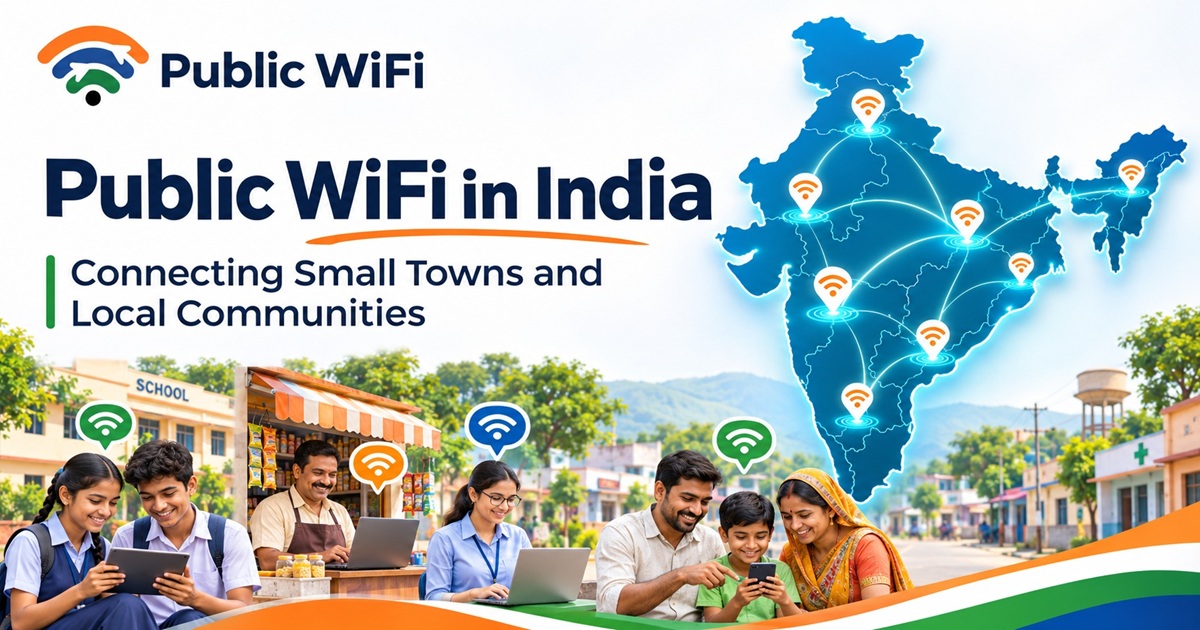
Public WiFi in India: Connecting Small Towns and Local Communities
Internet connectivity is no longer a luxury. It has become an essential part of everyday life, connecting people to education, employment, healthcare, digital payments, and government services.
India has made significant progress in expanding digital connectivity. However, access to affordable and reliable internet remains an important consideration for people living in smaller towns, semi-urban areas, and local communities.
Public WiFi in India offers an opportunity to make internet access more convenient by providing shared wireless connectivity at shops, markets, educational centres, residential neighbourhoods, and other public locations.
Rather than relying exclusively on mobile data or individual broadband connections, people can use public WiFi hotspots available in their surrounding communities.
In this article, we explore how public WiFi can support smaller towns, benefit local businesses, improve digital accessibility, and help communities participate in India's growing digital economy.
Why Small Towns Need Better Internet Connectivity
India's digital transformation extends beyond major metropolitan cities such as Delhi, Mumbai, Bengaluru, and Hyderabad.
People living in smaller cities, district headquarters, and rural communities increasingly depend on online services for their daily activities.
Consider a typical small town where:
- Students attend online classes and prepare for competitive examinations.
- Shopkeepers receive digital payments and manage online orders.
- Young professionals apply for jobs and attend virtual interviews.
- Families access government services and important documents.
- Local entrepreneurs promote their businesses through digital platforms.
- Residents communicate with relatives through video calls and messaging applications.
All these activities require internet connectivity.
Although mobile networks provide widespread internet access, factors such as network congestion, indoor coverage, data limits, and affordability can sometimes affect the user experience.
Public WiFi hotspots can complement existing connectivity options by offering internet access at convenient shared locations.
What Is Community-Based Public WiFi?
Community-based public WiFi refers to wireless internet infrastructure designed to serve people within a particular neighbourhood, market, institution, or public gathering location.
Unlike conventional home broadband, which primarily serves a single household, community WiFi hotspots can provide internet access to multiple authorised users.
For example, a local shopkeeper might offer public WiFi connectivity to customers through a suitable internet connection and hotspot management system.
Similarly, a community centre or educational institution could make WiFi available to eligible users within its premises.
How Community WiFi Works
A typical public WiFi hotspot requires:
- Internet connectivity: A broadband or other suitable internet connection provides access to the internet.
- WiFi equipment: Wireless access points distribute connectivity within the supported coverage area.
- User authentication: Users may log in through an approved authentication method, such as OTP verification or a captive portal.
- Internet access plans: Depending on the provider, users may access free, prepaid, or subscription-based services.
- Network management: The hotspot operator manages users, network performance, bandwidth, and security.
The technical implementation varies depending on the operator, equipment, and applicable service requirements.
7 Ways Public WiFi in India Can Transform Local Communities
1. Making Digital Education More Accessible
Education is one of the important areas where affordable internet connectivity can make a difference.
Students in smaller towns increasingly use online platforms for academic learning and career preparation.
They may need internet access to:
- Attend online classes.
- Download educational materials.
- Prepare for competitive examinations.
- Watch instructional videos.
- Submit online assignments.
- Access digital libraries and research resources.
A public WiFi hotspot near a library, coaching centre, or student accommodation can provide an additional connectivity option.
For example, a student preparing for competitive examinations may benefit from a nearby hotspot that offers sufficient speed and data allowance for educational videos and online practice tests.
When supported by suitable infrastructure, affordable public WiFi in India can help reduce connectivity-related barriers to digital learning.
2. Supporting Small Shops and Local Businesses
Small businesses are essential to India's local economy.
Today, even a small retail shop may depend on internet access for digital payments, billing software, inventory management, customer communication, and online promotions.
Public WiFi can support local businesses in two ways.
Internet access for business operations
A reliable connection can help shopkeepers use cloud-based applications, communicate with suppliers, and manage digital transactions.
Internet access for customers
Businesses may provide guest WiFi as an additional convenience for visitors.
Cafés, restaurants, shopping establishments, waiting areas, and service centres can potentially benefit from offering customer internet access.
However, businesses should use appropriate guest-network isolation and security controls rather than exposing internal systems to public users.
3. Helping Job Seekers and Young Professionals
Employment opportunities are increasingly connected to digital platforms.
Job seekers frequently need internet access to search vacancies, upload resumes, complete application forms, attend interviews, and participate in online training programmes.
For individuals without consistent internet access at home, a nearby public hotspot may provide a useful alternative.
Public WiFi can also support freelancers and professionals who need temporary access to cloud applications, email, and online collaboration tools.
The connection should offer sufficient reliability, speed, and security for the intended activity.
4. Making Digital Services Easier to Access
Many essential services are now accessible online.
Examples include:
- Government application portals.
- Digital document services.
- Online appointment booking.
- Educational admissions.
- Utility bill payments.
- Banking information and customer support.
- Public-service information portals.
Public WiFi hotspots can help users access these services without requiring a permanent broadband subscription.
For sensitive transactions, users should follow appropriate security precautions and use official websites or applications.
5. Improving Connectivity in Local Markets
Local markets bring together shoppers, vendors, service providers, and small business owners.
A properly designed public WiFi network could serve a defined market area, subject to physical coverage limitations and available infrastructure.
Potential uses include checking online catalogues, accessing digital services, communicating with customers, and using business applications.
Multiple access points may be required to provide coverage across larger areas.
6. Creating Opportunities for Local Entrepreneurs
Public WiFi is not only useful for internet users. It can also present business opportunities for entrepreneurs interested in operating connectivity services.
Depending on the applicable regulatory framework and commercial arrangements, local businesses may be able to participate in providing public internet access.
India's PM-WANI (Prime Minister's Wi-Fi Access Network Interface) framework was introduced to encourage the expansion of public WiFi through a decentralised ecosystem.
Under the framework, eligible participants can contribute to establishing and managing public WiFi services.
Before launching a hotspot business, prospective operators should understand the relevant requirements, infrastructure costs, provider arrangements, and ongoing maintenance obligations.
7. Supporting Digital Inclusion
Digital inclusion means helping more people access and benefit from digital technologies.
For some households, purchasing multiple mobile data subscriptions or maintaining a dedicated broadband connection may not be practical.
Public WiFi can offer another way to connect, especially when hotspots are conveniently located and reasonably priced.
However, physical availability alone does not guarantee digital inclusion.
Affordable pricing, suitable devices, digital literacy, reliable infrastructure, and accessible authentication processes also matter.
Public WiFi in Tier-2 and Tier-3 Cities in India
Tier-2 and Tier-3 cities, as commonly described in business and market discussions, represent an important opportunity for expanding shared internet infrastructure.
These cities and towns often have growing populations of students, professionals, traders, and small business owners who require connectivity.
Consider places such as:
- Patna and Gaya, Bihar: Educational institutions, coaching centres, and local businesses create varied connectivity needs.
- Muzaffarpur and Bhagalpur, Bihar: Commercial activities and student populations may benefit from accessible hotspot services.
- Ranchi and Hazaribagh, Jharkhand: Educational centres, local markets, and residential communities present potential use cases.
- Varanasi and Gorakhpur, Uttar Pradesh: Tourism, education, and commercial services create opportunities for public internet access.
- Darbhanga and Purnia, Bihar: Local institutions, markets, and neighbourhoods may benefit from additional connectivity options.
These are examples of communities where public WiFi could be useful, not claims that specific hotspots are currently operational.
Availability depends on local infrastructure and service providers.
To explore listed locations, visit the Public WiFi Coverage page.
What Makes a Good Public WiFi Hotspot in India?
Not all public WiFi networks offer the same experience.
The quality of a hotspot depends on several technical and operational factors.
| Factor | Why It Matters |
|---|---|
| Internet speed | Affects browsing, streaming, downloads, and video calls |
| Network reliability | Reduces unexpected interruptions |
| Coverage area | Determines where users can connect |
| Affordable plans | Makes connectivity accessible to more users |
| Simple authentication | Helps users connect without unnecessary complexity |
| Security | Helps protect users and network infrastructure |
| Customer support | Assists with login, payment, and connection problems |
| Device compatibility | Supports smartphones, laptops, and tablets |
A successful public WiFi service should balance performance, affordability, usability, and security.
How Public WiFi Can Complement Mobile Internet
Public WiFi and mobile internet are not necessarily competing technologies.
They serve different purposes and can work together.
Mobile data offers internet access while travelling or moving between locations, provided mobile network coverage is available.
Public WiFi is often most useful when users remain at a particular location, such as a shop, café, library, workplace, or residential area.
For example, a student might use mobile data while travelling and connect to an available public WiFi hotspot while studying at a library.
Similarly, a professional may use mobile internet during a commute and connect to WiFi at a supported workspace.
This combination can provide greater flexibility in managing internet usage.
How to Find Public WiFi in India
Finding nearby WiFi services is easier when providers publish location-based coverage information.
Public WiFi provides a platform for exploring wireless internet connectivity at supported locations.
Step 1: Explore Coverage
Visit Public WiFi Coverage.
Browse the available locations by state, district, and locality.
Step 2: Check Your Location
Review the listed hotspots and available coverage information for your intended area.
A listed location should be checked for current service availability before making travel or connectivity plans.
Step 3: Compare Internet Plans
Visit Public WiFi Plans to explore the available subscription options.
Consider the plan's validity, data allowance, internet speed, supported devices, and terms of service.
Step 4: Connect to the Official Hotspot
When you are within range of an available hotspot, confirm its official network name and follow the provider's authentication process.
Depending on the service, registration or plan activation may be required.
Step 5: Start Using the Internet
After successful authentication, you can use the connection according to the applicable plan and network conditions.
Challenges in Expanding Public WiFi Across Small Towns
Although public WiFi offers significant opportunities, deploying and maintaining networks can involve challenges.
Broadband Infrastructure
A public WiFi hotspot needs reliable underlying internet connectivity.
Locations with limited broadband infrastructure may face difficulties delivering consistent service.
Power Availability
Wireless access points and network equipment require electricity.
Power interruptions can disrupt connectivity unless suitable backup systems are installed.
Equipment and Maintenance
Public WiFi networks need appropriate routers, access points, cabling, monitoring, and periodic maintenance.
Network Congestion
When too many users connect simultaneously, bandwidth may become insufficient.
Effective capacity planning and fair-usage policies can help manage performance.
Commercial Sustainability
Operators must consider infrastructure investments, recurring internet costs, maintenance, customer support, and expected revenue.
A sustainable service model is important for long-term availability.
Security and Privacy
Shared connectivity environments require appropriate authentication, network isolation, privacy safeguards, and security controls.
Addressing these challenges is essential for building dependable community WiFi services.
The Future of Public WiFi in India's Local Communities
As more services move online, access to dependable internet connectivity will remain important for both cities and smaller communities.
Public WiFi could increasingly support neighbourhood connectivity through:
- Additional hotspots in commercial and residential areas.
- Improved broadband backhaul.
- Simpler authentication methods.
- Flexible prepaid internet plans.
- Better hotspot discovery platforms.
- More opportunities for local connectivity providers.
- Improved network management and security.
Government initiatives such as PM-WANI may also help encourage public WiFi participation, subject to continued implementation and local commercial feasibility.
The long-term success of public WiFi will depend on delivering services that people can easily find, afford, and use.
Why Choose Public WiFi?
Public WiFi is an Indian wireless internet connectivity platform focused on helping users explore accessible public WiFi services.
The platform offers information about supported locations, connectivity plans, and practical WiFi guidance.
Explore WiFi Coverage
Search listed coverage areas by state, district, and locality.
Find Suitable Internet Plans
Review available subscription options based on your connectivity requirements.
Learn More About Wireless Connectivity
Discover guides on public WiFi, network security, internet performance, and wireless technology.
Whether you live in a large city or a smaller town, exploring available hotspot options can help you identify additional ways to stay connected.
Frequently Asked Questions
1. How can Public WiFi in India help small towns?
Public WiFi can provide additional internet access at shared locations, supporting students, small businesses, professionals, and other community members who need affordable connectivity.
2. Is public WiFi available in small towns in India?
Public WiFi availability varies by location. Some smaller towns have public hotspots, while others may have limited services. Users should check local coverage and confirm hotspot availability.
3. Can a local shop provide public WiFi to customers?
Yes, a shop may offer guest WiFi through a suitable connectivity arrangement. Businesses should follow applicable service requirements and implement appropriate network security.
4. Is public WiFi cheaper than mobile data?
Public WiFi may be more economical for certain usage patterns, but pricing depends on the provider, plan duration, data limits, and connection requirements. Comparing actual costs is recommended.
5. How does public WiFi benefit students in India?
Students can use available hotspots to access online classes, educational videos, digital libraries, examination portals, and other learning resources.
6. Can public WiFi be used for online work?
Yes, provided the network has adequate performance and reliability. Users should protect sensitive information and follow their employer's security requirements when connecting to shared networks.
7. What is the difference between community WiFi and home WiFi?
Community WiFi provides internet access to multiple authorised users at shared locations, while home WiFi is typically intended for a private household.
8. How can I find public WiFi coverage in my district?
Visit Public WiFi Coverage and browse the listed locations by state, district, and locality. Confirm that service is available at your intended hotspot.
Conclusion
Public WiFi in India has the potential to play an increasingly important role in connecting smaller towns, neighbourhoods, and local communities.
By providing internet access at convenient shared locations, public WiFi can support digital education, business productivity, employment opportunities, and access to essential online services.
It can also create opportunities for local entrepreneurs interested in participating in the connectivity ecosystem.
However, expanding public WiFi requires more than installing wireless equipment. Reliable broadband infrastructure, affordable pricing, effective network management, security, and ongoing support are equally important.
As India's digital economy continues to develop, community-focused WiFi services can complement existing mobile and broadband networks.
Looking for Public WiFi in India?
Explore supported locations and internet access options through Public WiFi.
- Website: https://public-wifi.co.in/
- Explore Coverage: https://public-wifi.co.in/coverage
- View WiFi Plans: https://public-wifi.co.in/plans
- Contact Support: https://public-wifi.co.in/contact
Public WiFi — Connecting Communities, Empowering Digital India.