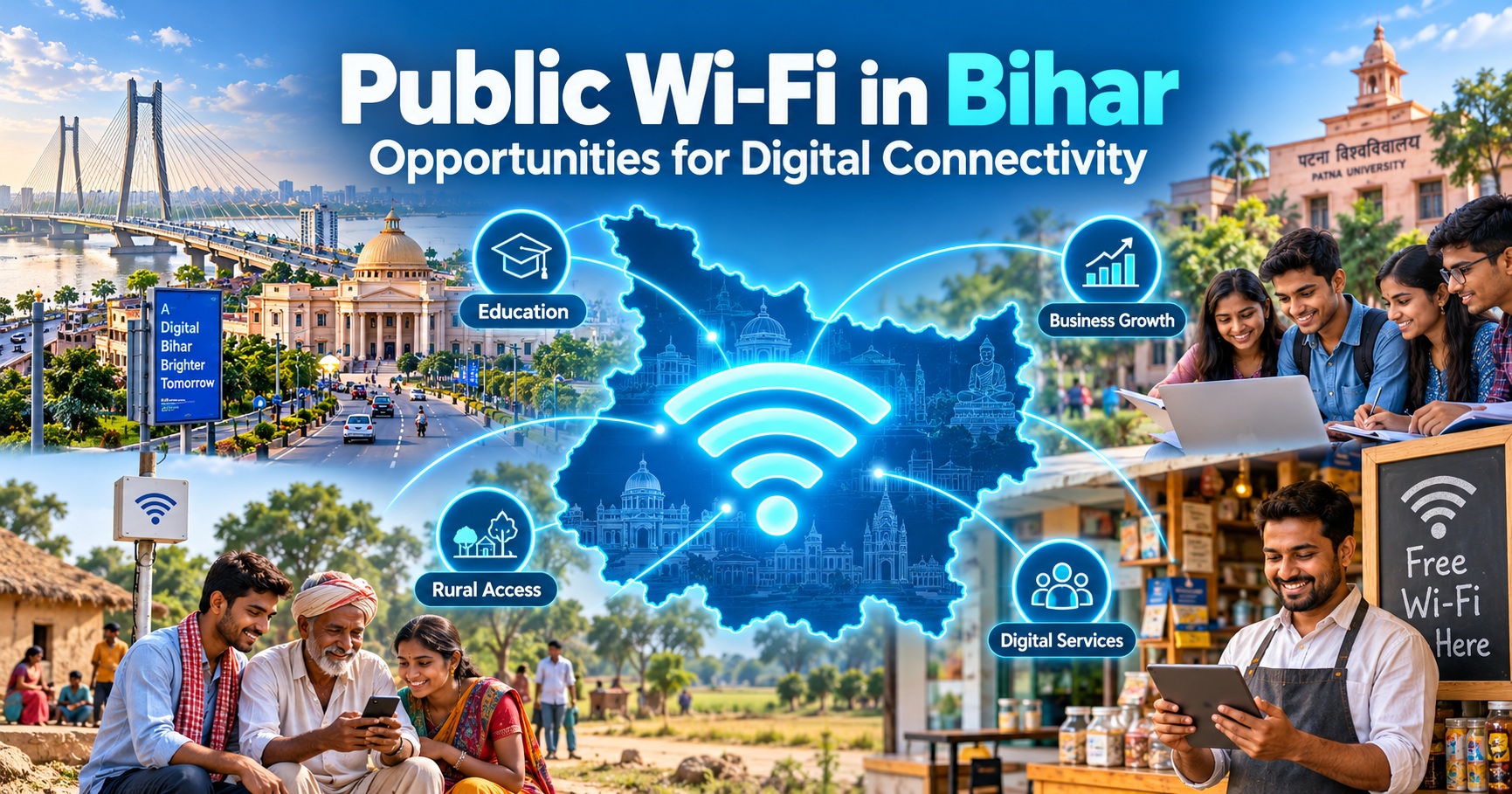
Introduction
Imagine a student in a small village in Bihar preparing for a competitive examination, a shopkeeper in Patna looking for new business opportunities, or a young entrepreneur in Muzaffarpur launching an online business.
What do they all have in common?
They need reliable, accessible, and affordable internet connectivity.
In today's digital world, the internet is essential for education, employment, business, communication, and accessing important public services.
While mobile networks and broadband services have expanded internet access across India, connectivity challenges can still affect some communities, particularly where reliable fixed-line broadband is unavailable, expensive, or difficult to install.
This is where public Wi-Fi hotspots in Bihar can create meaningful opportunities.
Public Wi-Fi allows people to access the internet at shared locations such as shops, cafés, educational institutions, libraries, railway stations, and community centers.
For Bihar, expanding public Wi-Fi could support digital education, encourage entrepreneurship, improve access to online services, and create opportunities for local businesses.
Government initiatives such as PM-WANI (Prime Minister Wi-Fi Access Network Interface) also provide a framework for expanding public Wi-Fi networks in India.
In this guide, we'll explore the current public Wi-Fi landscape, opportunities across Bihar's cities and rural communities, potential business models, and the practical steps involved in establishing public hotspots.
1. What Is Public Wi-Fi?
Public Wi-Fi is a wireless internet service that provides connectivity to people in public or shared locations through a Wi-Fi hotspot.
Unlike private home broadband, public WiFi is designed to serve visitors, customers, travelers, students, and other authorized users.
Public Wi-Fi networks may be offered through:
- Free access supported by a business or institution.
- Password-protected guest networks.
- Paid hourly or daily internet plans.
- Prepaid vouchers or subscriptions.
- Captive portal authentication.
- PM-WANI-compatible hotspot services.
How Does Public Wi-Fi Work?
A typical public Wi-Fi network uses an internet connection, wireless access point, and optional user authentication system.
       Internet Service Provider
                  |
                  |
             Wi-Fi Router
                  |
           Wireless Hotspot
                  |
       -----------------------
       |          |          |
    Student     Business   Traveler
       |          |          |
       -----------------------
                  |
          Internet Access
Users connect through their smartphones, laptops, or tablets.
Depending on the provider, they may need to enter a password, complete OTP verification, log in through a captive portal, or activate a prepaid plan.
Related Reading: What Is Public Wi-Fi? A Complete Beginner's Guide
2. Why Is Digital Connectivity Important for Bihar?
Bihar has significant opportunities for digital development across education, commerce, entrepreneurship, and community services.
Reliable internet access can help people participate in the growing digital economy.
2.1 Digital Education
Students increasingly use online resources to prepare for school examinations, college courses, competitive examinations, and professional certifications.
They need connectivity for:
- Recorded video lectures.
- Online classes.
- Digital textbooks.
- Examination registration.
- Online mock tests.
- Scholarship applications.
- Educational research.
Public Wi-Fi can provide another connectivity option for students without reliable home broadband.
2.2 Employment and Skill Development
Job seekers depend on internet access for:
- Government recruitment notifications.
- Job applications.
- Online interviews.
- Professional training.
- Resume preparation.
- Digital certification programs.
Affordable hotspot access could help individuals use these resources.
2.3 Small-Business Development
Local entrepreneurs increasingly rely on online tools for everyday activities.
For example, businesses may use the internet to manage:
- Digital payments.
- Online product listings.
- Customer communication.
- Inventory applications.
- Digital advertising.
- Online ordering.
Public Wi-Fi may help strengthen connectivity at commercial locations.
2.4 Government and Citizen Services
People use online platforms to obtain information, download forms, submit applications, and access various government services.
Reliable internet access can make these services more convenient, although some applications require additional security precautions.
2.5 Digital Inclusion
Digital inclusion means creating opportunities for more people to access and benefit from digital technologies.
Public Wi-Fi can be part of that effort, especially when combined with digital literacy, affordable devices, reliable electricity, and suitable internet infrastructure.
3. Public Wi-Fi in Bihar: Existing Connectivity and Opportunities
Public Wi-Fi is not an entirely new concept in Bihar.
A Telecom Regulatory Authority of India (TRAI) report listed 31,105 public WiFi hotspots and 33,232 access points in Bihar as of September 30, 2024.
This is a historical snapshot, not a verified count of operational hotspots in October 2026. Actual service availability, reliability, and coverage must be checked separately.
The figures demonstrate the presence of public Wi-Fi infrastructure, but they do not establish that every location has affordable, reliable internet access.
Where Could Additional Hotspots Be Useful?
Potential locations include:
- Educational neighborhoods.
- Student accommodation areas.
- Marketplaces and shopping streets.
- Bus terminals and transport hubs.
- Tourist destinations.
- Hospitals and waiting areas.
- Community facilities.
- Villages with suitable internet backhaul.
The best deployment locations are not necessarily the busiest places. Commercial viability also depends on user demand, existing competition, internet costs, and willingness to pay.
4. Opportunities for Public Wi-Fi in Major Cities of Bihar
Different cities have different customer groups, commercial activities, and connectivity requirements.
The following locations represent potential markets for further feasibility studies, not confirmed gaps in existing public WiFi coverage.
4.1 Patna: Education, Business, and Urban Connectivity
Patna is Bihar's capital and an important center for education, business, administration, and transportation.
Public WiFi may be useful around:
- Coaching and educational institutions.
- Student residential neighborhoods.
- Commercial markets.
- Cafés and restaurants.
- Coworking and shared workspaces.
- Transport facilities.
- Community learning centers.
Opportunities in Patna
Student Connectivity
Students preparing for competitive examinations may benefit from affordable internet access for online classes, mock tests, and digital study materials.
Business Connectivity
Retailers, cafés, and small establishments may explore customer WiFi as an additional service.
Hotspot Partnerships
Shop owners may investigate partnerships with eligible hotspot service providers.
Potential Deployment Areas
Localities such as Boring Road, Kankarbagh, Rajendra Nagar, Ashok Rajpath, and areas near educational institutions could be evaluated for demand.
These are candidate areas for market research; no claim is made here that these neighborhoods currently lack service.
4.2 Gaya and Bodh Gaya: Education and Tourism
Gaya and Bodh Gaya attract students, residents, domestic travelers, and international visitors.
Potential public WiFi uses include:
- Travel information.
- Online bookings.
- Maps and navigation.
- Translation services.
- Educational resources.
- Communication applications.
Guesthouses, cafés, restaurants, and commercial establishments may benefit from offering connectivity to visitors.
4.3 Muzaffarpur: Commercial and Educational Connectivity
Muzaffarpur is an important urban and commercial center in North Bihar.
Public WiFi opportunities may exist near educational institutions, markets, transport facilities, and business areas.
Students, shopkeepers, and service businesses could benefit from reliable shared connectivity.
4.4 Bhagalpur: Local Business and Student Connectivity
Bhagalpur has educational institutions and commercial activity, including its well-known silk-related industries.
Public Wi-Fi could support:
- Students accessing online learning.
- Small businesses using digital platforms.
- Traders communicating with customers.
- Visitors navigating commercial areas.
- Local entrepreneurs learning new digital skills.
4.5 Darbhanga: Education and Regional Services
Darbhanga serves as an important center in the Mithila region.
Potential applications include student internet access, connectivity in commercial areas, guest WiFi at establishments, and access to online public services.
4.6 Other Cities and Towns
Locations such as Purnia, Bihar Sharif, Begusarai, Ara, Chapra, Samastipur, and Motihari may also merit assessment.
In each case, hotspot deployment should depend on local surveys, available infrastructure, and a realistic business plan.
5. How Public Wi-Fi Can Benefit Students in Bihar
Education is one of the most promising applications of affordable public internet access.
Access to Online Classes
Students can use public WiFi for educational videos, recorded lectures, and virtual classes when the hotspot provides suitable speed and stability.
Competitive Examination Preparation
Students preparing for examinations such as BPSC, UPSC, SSC, banking, railway recruitment, JEE, and NEET often need access to online resources.
Public Wi-Fi may help them download study materials, attend classes, and complete mock tests.
Access to Digital Libraries
Students can access platforms such as:
- SWAYAM
- DIKSHA
- National Digital Library of India
- ePathshala
Skills Development
Internet access can support learning in areas such as programming, digital marketing, graphic design, English communication, and online entrepreneurship.
Example: A Student in Rural Bihar
Consider a student living in a village without dependable home broadband.
The student needs to watch recorded lectures and download examination preparation materials.
If an affordable hotspot is available at a nearby authorized community location, the student may be able to download learning resources and study offline later.
Such a service could reduce dependence on mobile data, although the actual savings would depend on travel costs, hotspot pricing, and available mobile plans.
Related Reading: Benefits of Public Wi-Fi for Students and Professionals
6. How Public Wi-Fi Can Help Rural Bihar
Public Wi-Fi could provide an additional way to extend access to the internet in areas where fixed broadband connectivity is limited.
Potential Rural Applications
Digital Learning
Students could access online educational materials from shared locations.
Employment Information
Job seekers could use available internet access to review recruitment notices and submit applications.
Agricultural Information
Farmers could access weather forecasts, market information, agricultural guidance, and official information services.
Digital Skills
Community facilities could support digital literacy and basic computer training.
Local Entrepreneurship
Small businesses could explore online sales, communication tools, and digital marketing.
Where Could Rural Hotspots Be Installed?
Possible locations include:
- Shops and commercial establishments.
- Community centers.
- Educational facilities with permission.
- Libraries.
- Authorized public-service locations.
- Local markets.
However, successful deployment requires more than simply installing a Wi-Fi router.
Reliable internet backhaul, power availability, technical maintenance, local demand, and appropriate security are all important.
7. PM-WANI: A Framework for Expanding Public Wi-Fi
The Prime Minister Wi-Fi Access Network Interface (PM-WANI) framework was introduced by the Government of India to facilitate the expansion of public Wi-Fi networks.
The framework supports an ecosystem in which different entities perform roles related to hotspot operation, aggregation, user authentication, and service discovery.
Key Participants in the PM-WANI Ecosystem
| Participant | Main Role |
|---|---|
| Public Data Office (PDO) | Operates compliant public Wi-Fi access points |
| Public Data Office Aggregator (PDOA) | Supports hotspot aggregation, authorization, accounting, and related services |
| App Provider | Supports user registration, authentication, and hotspot discovery |
| Central Registry | Maintains relevant ecosystem records |
Can a Shopkeeper Become a PDO?
The PM-WANI framework allows eligible local establishments to explore operating public Wi-Fi access points as PDOs.
According to the Department of Telecommunications, PDOs do not individually require PM-WANI service authorisation, while PDOAs and App Providers have applicable authorisation requirements.
Businesses must still follow relevant technical rules, internet service conditions, commercial agreements, security requirements, and other applicable obligations.
Opportunities for Bihar
The framework may create opportunities for:
- Small shop owners.
- Café and restaurant operators.
- Local entrepreneurs.
- Internet service partners.
- Community connectivity initiatives.
8. Public Wi-Fi Business Opportunities in Bihar
Public Wi-Fi is not only a connectivity service. Under suitable commercial conditions, it may also become a business opportunity.
8.1 Shop-Based Public Wi-Fi Hotspots
Small establishments may host guest Wi-Fi or participate in supported public hotspot arrangements.
Potential advantages include:
- Additional customer convenience.
- Opportunities for paid internet access.
- Possible customer footfall.
- Participation in local connectivity services.
8.2 Café and Restaurant Wi-Fi
Cafés may offer free, time-limited, or paid access depending on their customer base.
Students and professionals may prefer locations with reliable internet access and comfortable seating.
8.3 Hotspots Near Educational Institutions
Locations near colleges, coaching centers, and student residential areas may have demand for affordable connectivity.
Operators should assess current mobile data prices, available broadband alternatives, and students' willingness to pay.
8.4 Community Hotspot Services
Community facilities may explore shared internet access for educational and local-service applications.
8.5 Hotspot Installation and Support
Local technical businesses may offer legitimate services such as:
- Site surveys.
- Wi-Fi equipment installation.
- Network configuration.
- Coverage optimization.
- Security configuration.
- Maintenance and troubleshooting.
8.6 Partnerships with Network Operators
Businesses may investigate commercial partnerships with appropriate internet and hotspot service providers.
Partnership terms should clearly define installation costs, connectivity responsibilities, revenue sharing, technical support, customer service, and applicable regulatory compliance.
Related Reading: Benefits of Offering Public Wi-Fi in Shops and Cafés
9. Free Public Wi-Fi vs Paid Public Wi-Fi in Bihar
Businesses need to choose a model that matches customer demand and operating costs.
| Feature | Free Public Wi-Fi | Paid Public Wi-Fi |
|---|---|---|
| Customer Cost | No direct charge | Plan or voucher fee |
| Main Objective | Customer convenience | Connectivity service and possible revenue |
| Direct Access Revenue | Usually none | Possible |
| Cost Recovery | Indirect business benefits | Through user payments where viable |
| Usage Management | Recommended | Essential |
| Typical Applications | Cafés, hotels, guest facilities | Dedicated or managed hotspots |
Which Model Could Work Better?
Free Wi-Fi may suit businesses that primarily want to improve customer service.
Paid Wi-Fi may be worth testing where users need connectivity and are willing to pay for a reliable service.
Hybrid Wi-Fi may provide limited complimentary access with optional paid plans, if the management platform supports it.
The most suitable model depends on actual customer demand and the cost of delivering the service.
10. What Does It Cost to Set Up a Public Wi-Fi Hotspot?
The initial cost depends on the location, equipment, internet service, installation, and hotspot management requirements.
Typical Expense Categories
| Component | Expense Type |
|---|---|
| Wireless Router or Access Point | Initial |
| Internet Connection | Recurring |
| Gateway or Network Controller | Initial or subscription |
| Captive Portal Platform | Optional recurring |
| Installation and Cabling | Initial |
| Maintenance | Recurring or occasional |
| Electricity and Backup | Initial and recurring |
Illustrative Small-Hotspot Budget
The following values are planning assumptions only, not verified quotations for Bihar.
| Expense | Illustrative Amount |
|---|---|
| Router / Access Point | ₹3,000 |
| Installation and Cabling | ₹1,500 |
| Initial Setup Total | ₹4,500 |
| Monthly Internet Connection | ₹1,000 |
| Monthly Management and Maintenance | ₹300 |
| Illustrative Monthly Operating Cost | ₹1,300 |
Actual costs may differ substantially depending on equipment quality, installation requirements, bandwidth, service agreements, and maintenance.
Can a Hotspot Earn Money?
Consider a hypothetical paid hotspot.
Suppose it serves 20 paying users per day at an average realized price of ₹10 per user.
Daily Gross Revenue
20 users × ₹10 = ₹200

Monthly Gross Revenue
₹200 × 30 days = ₹6,000

Illustrative Operating Cost
₹1,300 per month

Illustrative Difference
₹6,000 - ₹1,300 = ₹4,700
This is not a profit forecast. It excludes payment processing charges, taxes, equipment depreciation, partner commissions, rent, customer acquisition, and other possible expenses.
It also assumes that 20 customers pay every day, which would need to be validated through a real market test.
Business decisions should be based on measured demand, not assumed daily customer numbers.
11. How to Choose a Suitable Hotspot Location in Bihar
Location selection is one of the most important parts of a public Wi-Fi business.
Evaluate Customer Demand
Identify whether people in the area actually need additional connectivity.
Check Existing Competition
Assess available mobile data plans, broadband access, and other nearby hotspots.
Consider Customer Footfall
Locations with consistent visitor traffic may have a larger potential user base.
Assess Available Internet Backhaul
Reliable upstream connectivity is essential.
Review Electricity Availability
Power interruptions may require backup equipment.
Check Commercial Suitability
Consider space availability, equipment security, rental costs, and permissions.
Conduct a Small Pilot
Before expanding, test a location and measure:
- Daily connection attempts.
- Successful authentications.
- Unique active users.
- Average usage per user.
- Paid conversion rates, where applicable.
- Network uptime.
- Customer complaints.
- Net revenue and costs.
A pilot can provide useful information about whether a proposed hotspot is commercially sustainable.
12. Challenges of Expanding Public Wi-Fi in Bihar
Public Wi-Fi creates opportunities, but operators must also address practical challenges.
12.1 Internet Backhaul Availability
Some locations may lack suitable broadband or other reliable upstream connectivity.
12.2 Electricity and Power Backup
Unreliable electricity can disrupt hotspot operation.
12.3 Affordable Pricing
Operators may need competitive prices because many customers already have mobile data subscriptions.
12.4 Equipment and Maintenance Costs
Routers, cabling, backup equipment, and technical support create ongoing expenses.
12.5 Customer Awareness
Users may not understand how to find or connect to a managed public hotspot.
12.6 Network Security
Public hotspots require appropriate network isolation, secure equipment, and responsible user authentication.
12.7 Customer Privacy
Operators should provide clear privacy information and protect personal data in accordance with applicable requirements.
12.8 Commercial Sustainability
A busy location does not necessarily produce high paid usage.
Operators should validate demand and calculate total costs before expanding.
13. How to Connect Safely to Public Wi-Fi in Bihar
Public Wi-Fi can be convenient, but users should follow basic security practices.
- Verify the network name: Confirm the hotspot's official name before connecting.
- Use HTTPS websites: Prefer encrypted connections for online activities.
- Check the login page: Avoid suspicious portals requesting unrelated personal or financial information.
- Never share banking OTPs or UPI PINs: These are not required for ordinary Wi-Fi access.
- Keep devices updated: Install security updates regularly.
- Disable unnecessary file sharing: Reduce your device's exposure on shared networks.
- Follow workplace security rules: Use approved secure access tools when required.
- Disconnect when finished: Disable automatic reconnection to unfamiliar hotspots.
Related Reading: How to Connect to Public Wi-Fi Safely
14. The Future of Public Wi-Fi in Bihar
Public Wi-Fi could become an important complementary part of Bihar's digital connectivity infrastructure.
Several developments may influence future opportunities.
Expansion of Shared Internet Access
Hotspots may be deployed in locations where shared connectivity meets a specific community or commercial need.
Educational Connectivity
Students may benefit from affordable internet access near libraries, coaching centers, and educational facilities.
Small-Business Participation
Shops and cafés may explore managed guest networks or appropriate hotspot partnerships.
Improved Network Management
Modern access points, centralized management, and authentication systems can help operators manage networks more efficiently.
Integration with Digital Services
Public connectivity can complement online education, local business services, and access to digital information.
Community-Based Models
Local businesses and organizations may cooperate with eligible providers to make connectivity available at convenient locations.
The long-term success of public Wi-Fi in Bihar will depend on real demand, reliable infrastructure, reasonable pricing, and sustainable operations.
15. How Public WiFi Can Support Digital Connectivity
At Public WiFi, we believe that accessible and affordable wireless connectivity can help create opportunities for students, professionals, entrepreneurs, and local communities.
Bihar offers diverse opportunities to explore public hotspot services, from urban commercial areas to educational centers and rural communities.
Our goal is to help people understand public Wi-Fi technologies, responsible connectivity practices, and available internet-access solutions.
Whether you're a student looking for additional connectivity, a shop owner considering guest Wi-Fi, or an entrepreneur exploring hotspot opportunities, informed decisions are essential.
Explore Public WiFi
Visit https://public-wifi.co.in/ to learn more about public Wi-Fi hotspots and wireless internet connectivity.
Connecting Communities. Supporting Education. Enabling Digital Opportunities.
16. Frequently Asked Questions (FAQs)
Q1. Is public Wi-Fi available in Bihar?
Yes. Public Wi-Fi infrastructure has been reported in Bihar, although actual hotspot availability and service quality vary by location and provider.
Q2. Is public Wi-Fi free in Bihar?
Some hotspots may offer complimentary internet access, while others require paid plans or vouchers. Users should check the terms of the individual service.
Q3. Where can I find public Wi-Fi in Patna?
Potential sources include participating businesses, educational facilities, hotels, and supported public hotspot locations. Check with the operator for verified availability.
Q4. Can students use public Wi-Fi for online classes?
Yes, when the hotspot provides suitable speed, reliability, and access to the required educational platforms.
Q5. Can a shopkeeper start a public Wi-Fi business in Bihar?
A shopkeeper may explore guest Wi-Fi or eligible public hotspot arrangements, including participation through the PM-WANI ecosystem, subject to applicable requirements.
Q6. What is PM-WANI?
PM-WANI is a Government of India framework that supports public Wi-Fi access through an ecosystem involving PDOs, PDOAs, App Providers, and a Central Registry.
Q7. Does a PDO need individual PM-WANI authorisation?
According to the Department of Telecommunications, PDOs do not require individual PM-WANI authorisation. Other applicable service, technical, and commercial requirements still need to be followed.
Q8. Is public Wi-Fi profitable in rural Bihar?
It may be commercially viable at certain locations, but profitability depends on local demand, pricing, internet availability, equipment costs, and operating expenses.
Q9. Can public Wi-Fi help students prepare for BPSC examinations?
Yes. Reliable public Wi-Fi can help students access recorded lectures, study materials, mock tests, and examination-related information.
Q10. Can a café offer paid Wi-Fi?
A café may explore a paid hotspot model under appropriate commercial and regulatory arrangements. The internet connection's terms must permit the intended use.
Q11. How much does it cost to install a hotspot?
Costs vary depending on the equipment, connectivity, coverage requirements, installation, and management services. A site-specific quotation is needed.
Q12. Is public Wi-Fi secure?
Public Wi-Fi can support secure internet usage when properly configured and used responsibly. However, users should remain alert to fake hotspots, phishing websites, and insecure connections.
Q13. Can public Wi-Fi replace home broadband?
For occasional usage, a suitable hotspot may be an alternative. For frequent and continuous home internet usage, dedicated broadband may be more convenient.
Q14. Which areas of Bihar have the best business opportunities?
Potential areas include educational neighborhoods, commercial markets, transport-adjacent locations, and underserved communities. Each location requires a feasibility assessment.
Q15. How can I learn more about public Wi-Fi services?
Visit Public WiFi for information about public Wi-Fi, wireless internet connectivity, and hotspot-related topics.
Conclusion
Public Wi-Fi has the potential to support Bihar's digital development by providing additional internet access opportunities for students, businesses, professionals, and communities.
From educational neighborhoods in Patna to commercial centers in Muzaffarpur, tourist areas around Bodh Gaya, and rural communities, different locations may benefit from appropriately planned public hotspots.
The PM-WANI framework provides a structured opportunity for expanding public Wi-Fi access through eligible participants.
However, successful deployment requires careful attention to network availability, operating costs, security, affordability, and customer demand.
Public Wi-Fi should be seen as a complement to mobile networks and fixed broadband, rather than a universal replacement.
The key takeaway is simple: Affordable and reliable internet connectivity can help Bihar unlock opportunities in education, employment, entrepreneurship, and digital inclusion.
To explore public Wi-Fi technologies and connectivity solutions, visit Public WiFi.
Connecting Bihar. Empowering Communities. Building a Digital Future.