Introduction
Imagine you're sitting in a café, attending an online class, watching YouTube, or working remotely. You need a reliable internet connection, but you're unsure whether to connect to the available public Wi-Fi hotspot or continue using your mobile data.
Which option is faster? Which is more affordable? Which provides better security and reliability?
These are common questions for internet users today.
In India, mobile data services using 4G and 5G networks have made internet access increasingly convenient. At the same time, public Wi-Fi hotspots offer an alternative way to stay connected at locations such as cafés, railway stations, hotels, educational institutions, and commercial establishments.
Both technologies have advantages and limitations.
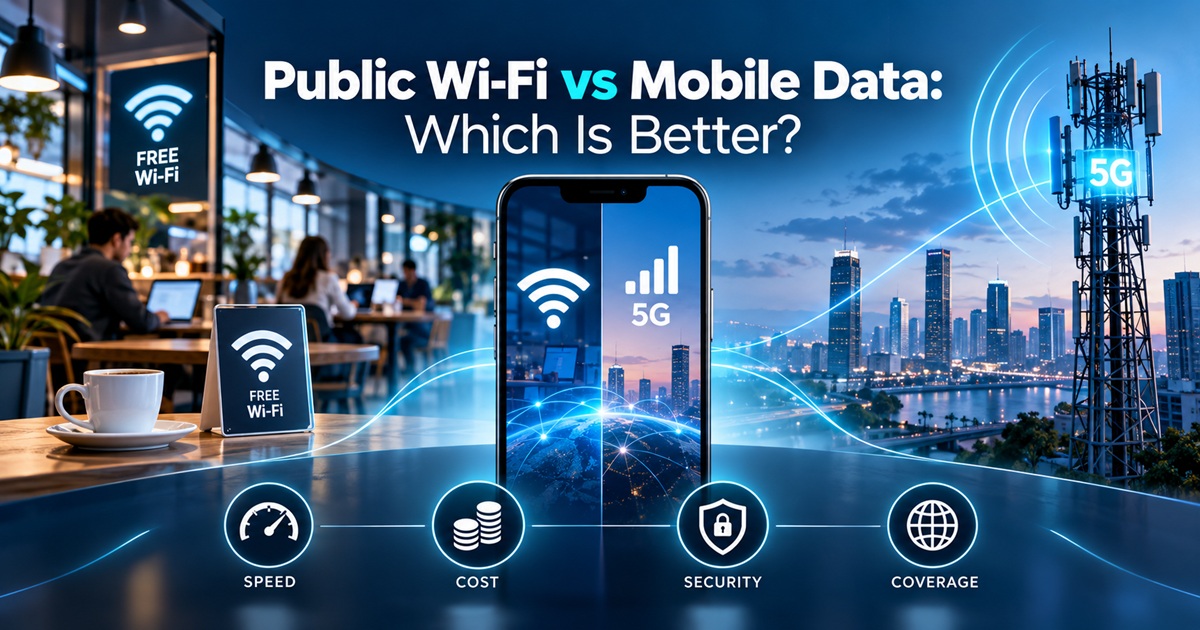
Public Wi-Fi can provide convenient, affordable internet access at supported locations, while mobile data offers greater mobility and wider geographical coverage.
However, choosing the right connection depends on several factors, including your location, internet usage, budget, network availability, and security requirements.
In this comprehensive guide, we'll compare public Wi-Fi vs mobile data, explain how each technology works, explore their advantages and disadvantages, and help you decide which option best suits your needs.
1. What Is Public Wi-Fi?
Public Wi-Fi is a wireless internet service that allows users to connect their devices to the internet through a shared Wi-Fi hotspot at a public or commercial location.
Public Wi-Fi networks are commonly available at:
- Railway stations and airports.
- Cafés and restaurants.
- Hotels and guesthouses.
- Shopping malls.
- Libraries and educational institutions.
- Coworking spaces.
- Commercial establishments.
- Dedicated public Wi-Fi hotspot locations.
Some public Wi-Fi networks provide free internet access, while others require a prepaid plan, voucher, password, or subscription.
How Does Public Wi-Fi Work?
A public Wi-Fi hotspot generally uses an existing internet connection provided through broadband, fiber, or another network connection.
A wireless router or access point broadcasts a Wi-Fi signal that nearby users can connect to.
The connection process typically involves:
- Turning on Wi-Fi on your device.
- Selecting the verified hotspot network.
- Entering a password or completing authentication if required.
- Activating an internet plan when applicable.
- Accessing the internet.
Some managed public hotspots use a captive portal, which is a browser-based login page that may require mobile OTP verification or other authorization.
Related Reading: What Is Public Wi-Fi? A Complete Beginner's Guide
2. What Is Mobile Data?
Mobile data is an internet service provided through cellular networks operated by telecommunications companies.
Mobile data allows smartphones and other supported devices to connect to the internet using technologies such as 4G LTE and 5G.
Unlike public Wi-Fi, mobile data does not normally require a nearby Wi-Fi access point.
Instead, your device connects to the cellular network using a SIM or eSIM and an active data service.
How Does Mobile Data Work?
When you enable mobile data:
- Your smartphone connects to a supported cellular network.
- The mobile operator authenticates your SIM or eSIM.
- Your device establishes a mobile data connection.
- You access internet services through the operator's network.
In India, operators such as Jio, Airtel, Vi, and BSNL provide mobile network services, although technologies and coverage vary.
Common Uses of Mobile Data
Mobile data is particularly useful for:
- Internet access while traveling.
- Navigation and maps.
- Messaging and communication.
- Mobile payments.
- Social media.
- Video streaming.
- General web browsing.
Its greatest advantage is the ability to maintain connectivity across a wider area without remaining close to a particular Wi-Fi hotspot.
3. Public Wi-Fi vs Mobile Data: Quick Comparison
Before examining each factor in detail, let's compare the main characteristics.
| Feature | Public Wi-Fi | Mobile Data |
|---|---|---|
| Technology | Wi-Fi wireless networking | 4G/5G cellular networks |
| Network Access | Through a nearby hotspot | Through a cellular operator |
| Coverage | Limited to hotspot coverage | Across supported mobile coverage areas |
| Mobility | Best at fixed locations | Designed for mobile connectivity |
| Cost | Free or paid access | Mobile recharge or data plan |
| Speed | Depends on hotspot and internet backhaul | Depends on cellular network and signal |
| Reliability | Depends on hotspot quality and congestion | Depends on mobile coverage and congestion |
| Security | Depends on hotspot configuration | Cellular security plus application protection |
| Authentication | Password, portal, voucher, or OTP | SIM/eSIM authentication |
| SIM Requirement | Not necessarily required | Generally required |
| Data Limits | Depends on hotspot plan | Depends on mobile plan |
| Best For | Connectivity at supported locations | Internet access while moving |
Quick Answer: Neither public Wi-Fi nor mobile data is universally better. The best choice depends on where and how you use the internet.
4. Public Wi-Fi vs Mobile Data: Which Is Faster?
Internet speed is one of the most important factors when choosing a connection.
However, public Wi-Fi is not automatically faster than mobile data, and 5G is not automatically faster than every Wi-Fi hotspot.
Actual performance depends on the network.
4.1 Public Wi-Fi Speed
Public Wi-Fi speed depends on:
- Internet connection capacity.
- Router and access point capabilities.
- Number of connected users.
- Distance from the access point.
- Network interference.
- Bandwidth management policies.
- Internet plan restrictions.
For example, a hotspot connected to high-speed fiber broadband may provide excellent performance when only a few people are connected.
However, the same hotspot may become slower when many users simultaneously stream videos or download large files.
4.2 Mobile Data Speed
Mobile data performance depends on:
- Available 4G or 5G coverage.
- Distance from the cellular tower.
- Network congestion.
- Signal strength.
- Building materials and obstacles.
- Device capabilities.
- Operator plan restrictions.
A strong 5G connection can provide high download speeds, but performance varies considerably by location.
4.3 Which Is Better for Speed?
Public Wi-Fi may be better when:
- The hotspot has a fast broadband connection.
- Few users share the network.
- You're close to the access point.
- The provider offers sufficient bandwidth.
Mobile data may be better when:
- The hotspot is overcrowded.
- The Wi-Fi signal is weak.
- Strong 4G or 5G coverage is available.
- The hotspot has restrictive speed limits.
Verdict
Winner: Depends on network conditions.
For the most accurate comparison, test both connections at the location where you plan to use them.
5. Public Wi-Fi vs Mobile Data: Which Is More Affordable?
Cost is especially important for students, frequent internet users, and budget-conscious customers.
Both public Wi-Fi and mobile data have different pricing structures.
5.1 Public Wi-Fi Pricing
Public Wi-Fi providers may offer:
- Free internet access.
- Hourly plans.
- Daily plans.
- Weekly plans.
- Monthly plans.
- Data-based packages.
- Prepaid vouchers.
Not every provider offers all these options.
Some commercial establishments provide complimentary internet access to customers, while dedicated hotspot operators may charge for connectivity.
5.2 Mobile Data Pricing
Mobile data generally requires an active mobile service plan.
A plan may include:
- Daily or total data allowances.
- A defined validity period.
- Speed restrictions.
- Fair usage conditions.
- Voice calling or other bundled services.
Actual benefits and pricing depend on the operator and selected plan.
5.3 Example Cost Comparison
Consider a student who frequently watches online lectures and downloads educational resources.
Suppose the student has two options:
Option A: Mobile Data
A hypothetical mobile plan costs ₹399 for 28 days.
Option B: Public Wi-Fi
A hypothetical hotspot plan costs ₹20 per day.
| Internet Option | Illustrative Cost |
|---|---|
| Mobile Plan | ₹399 per 28-day period |
| Public Wi-Fi for 30 Days | ₹300 |
| Difference | ₹99 |
These amounts are examples for explanation, not verified current market prices. The plans also may differ in data allowances, validity, mobility, and included benefits, so the costs are not directly equivalent.
If the student already pays for mobile service, purchasing hotspot access may become an additional expense rather than a replacement.
Verdict
Winner: Depends on the price and usage pattern.
Free public Wi-Fi is generally cheaper in direct access charges, while paid hotspots must be compared with the user's existing mobile plan.
6. Public Wi-Fi vs Mobile Data: Coverage and Availability
Coverage is one of the biggest differences between the two technologies.
Public Wi-Fi Coverage
Public Wi-Fi works within the wireless coverage area of a hotspot.
Once you move outside that area, your device may lose its connection.
Coverage depends on:
- Wireless access point placement.
- Router specifications.
- Building layout.
- Frequency band.
- Obstacles.
- Interference.
Public Wi-Fi works best when you remain within a supported location.
Mobile Data Coverage
Mobile data operates through cellular networks designed to cover larger geographical areas.
Users can access the internet while traveling across locations where their operator provides suitable coverage.
However, mobile service can still be weak or unavailable in some indoor spaces, rural areas, or other locations.
Verdict
Winner: Mobile Data.
Mobile data generally provides better mobility and wider geographical coverage.
Public Wi-Fi is better suited to locations where hotspot coverage is available.
7. Public Wi-Fi vs Mobile Data: Which Is More Secure?
Security is an important concern when connecting to the internet.
Both technologies can support secure online activities, but their risks differ.
7.1 Public Wi-Fi Security
Public Wi-Fi may be shared with many users.
Potential threats include:
- Fake wireless hotspots.
- Fraudulent login portals.
- Unencrypted communications.
- Malicious websites.
- Insecure device sharing.
- Poorly configured network equipment.
Modern HTTPS encryption helps protect communication between your device and legitimate websites.
However, users should still verify the hotspot and remain cautious.
7.2 Mobile Data Security
Cellular networks use security mechanisms to protect communication between devices and the mobile network.
Mobile data generally avoids some of the risks associated with joining an unfamiliar public Wi-Fi hotspot.
However, mobile data does not protect users from every threat.
Examples include:
- Phishing websites.
- Malicious applications.
- Fraudulent messages.
- Account compromise.
- Online scams.
7.3 Public Wi-Fi Safety Tips
When using public Wi-Fi:
- Verify the hotspot's official network name.
- Prefer HTTPS websites.
- Avoid suspicious login pages.
- Never disclose banking OTPs or UPI PINs.
- Keep your device updated.
- Use multi-factor authentication.
- Disable unnecessary file sharing.
- Use an approved VPN when required for work.
- Disconnect from untrusted networks after use.
Verdict
Winner: Mobile Data for avoiding the risks of unfamiliar public hotspots.
However, a properly managed public Wi-Fi connection can still be suitable for everyday online activities.
Related Reading: How to Connect to Public Wi-Fi Safely
8. Public Wi-Fi vs Mobile Data for Students
Students use the internet for online classes, research, examination preparation, and digital learning.
Advantages of Public Wi-Fi for Students
Public Wi-Fi may provide:
- Affordable internet access.
- Reduced mobile data consumption.
- Access to educational videos.
- Large study material downloads.
- Connectivity at libraries and study centers.
- An alternative when home broadband is unavailable.
Advantages of Mobile Data for Students
Mobile data offers:
- Internet access while traveling.
- Connectivity beyond hotspot locations.
- Convenient access to educational applications.
- No need to locate and log in to a hotspot.
- Flexibility for short study sessions anywhere within coverage.
Example
A student preparing for BPSC examinations in Patna regularly watches recorded classes and downloads study materials.
If a reliable, affordable hotspot is available near the student's study location, public Wi-Fi may be useful for high-volume downloads.
Mobile data remains valuable for accessing learning resources during travel or outside hotspot coverage.
Verdict
Best Choice: Use both when practical.
Public Wi-Fi can support study sessions at fixed locations, while mobile data provides flexibility.
9. Public Wi-Fi vs Mobile Data for Working Professionals
Professionals require reliable internet access for communication, meetings, cloud services, and remote work.
Public Wi-Fi for Professionals
Public Wi-Fi may be useful for:
- General internet browsing.
- Checking non-sensitive email.
- Accessing public information.
- Approved cloud applications.
- Online training.
- Video meetings when network quality permits.
However, employees should always follow their organization's security policies.
Mobile Data for Professionals
Mobile data is useful for:
- Traveling between meetings.
- Accessing navigation applications.
- Working outside hotspot coverage.
- Communicating while commuting.
- Maintaining a backup internet connection.
Which Is Better for Video Meetings?
Video meeting quality depends on:
- Upload and download speeds.
- Latency.
- Packet loss.
- Connection stability.
- Network congestion.
Either connection can work well when these conditions are satisfactory.
Verdict
Best Choice: Depends on mobility and connection quality.
Professionals who frequently travel may benefit more from mobile data, while a well-managed Wi-Fi hotspot may be convenient at fixed locations.
10. Public Wi-Fi vs Mobile Data for Travelers
Travelers need internet access for navigation, bookings, communication, and online information.
Public Wi-Fi Advantages
At supported locations, public Wi-Fi may help travelers:
- Access transportation information.
- Check hotel bookings.
- Download maps.
- Communicate online.
- Reduce mobile data consumption.
Mobile Data Advantages
Mobile data supports connectivity while moving between locations.
This makes it particularly useful for:
- Navigation.
- Ride-hailing applications.
- Real-time travel updates.
- Communication during journeys.
Verdict
Winner: Mobile Data for continuous travel connectivity.
Public Wi-Fi can be a helpful supplementary option at railway stations, hotels, cafés, and other supported locations.
11. Public Wi-Fi vs Mobile Data for Small Businesses
Small businesses increasingly use digital tools for communication, inventory, marketing, and customer services.
Public Wi-Fi Opportunities
A shop or café may offer guest Wi-Fi to:
- Improve customer convenience.
- Attract visitors seeking connectivity.
- Encourage repeat visits.
- Support customer digital engagement.
- Explore eligible paid hotspot arrangements.
Business owners should separate customer Wi-Fi from internal payment and administrative networks.
Mobile Data for Business Operations
Mobile data can support:
- Business communications.
- Field operations.
- Backup connectivity.
- Mobile business applications.
- Online services outside fixed locations.
For payment systems and critical business operations, reliability and security should take priority over connection cost alone.
Verdict
Best Choice: A suitable combination of fixed connectivity, guest Wi-Fi, and mobile backup.
Related Reading: Benefits of Offering Public Wi-Fi in Shops and Cafés
12. Public Wi-Fi vs Mobile Data in Rural Areas
Internet connectivity in rural communities depends on infrastructure availability and affordability.
Public Wi-Fi Opportunities
Where reliable backhaul exists, public Wi-Fi hotspots may provide shared internet access at:
- Community facilities.
- Educational institutions.
- Local markets.
- Shops.
- Libraries.
- Other authorized locations.
This can be useful when households do not have affordable fixed broadband.
Mobile Data Opportunities
Mobile networks provide internet access wherever supported coverage is available.
However, service quality may vary because of network infrastructure, terrain, buildings, and congestion.
Can Public Wi-Fi Help Bridge the Digital Divide?
Public Wi-Fi can complement mobile networks by making internet access available at shared locations.
In India, the PM-WANI framework supports an ecosystem for expanding public Wi-Fi access.
The framework provides opportunities for eligible local establishments and service providers to participate in public hotspot deployment.
Related Reading: Public Wi-Fi in Bihar: Opportunities for Digital Connectivity
13. Advantages and Disadvantages of Public Wi-Fi
Advantages
- Free access may be available at some locations.
- Can reduce mobile data usage.
- Useful for students and professionals.
- Supports multiple Wi-Fi-enabled devices.
- May provide high speeds with suitable infrastructure.
- Can improve customer convenience at businesses.
- May offer affordable short-duration internet plans.
Disadvantages
- Limited coverage area.
- Performance may decrease during congestion.
- Security depends on the hotspot.
- May require login or authentication.
- Some services have usage restrictions.
- Internet availability depends on the hotspot operator.
14. Advantages and Disadvantages of Mobile Data
Advantages
- Wider geographical coverage.
- Convenient for travel and movement.
- No need to search for hotspots.
- Supports internet access on the move.
- Works with supported smartphones and mobile devices.
- Avoids connecting to unfamiliar guest Wi-Fi networks.
Disadvantages
- Coverage may be weak in some locations.
- Speeds can decrease during congestion.
- Data allowances or fair usage restrictions may apply.
- Additional data can increase expenses.
- Battery consumption may increase during demanding network use.
- Connection quality depends on operator infrastructure.
15. How to Decide Between Public Wi-Fi and Mobile Data
The best connection depends on your situation.
| Your Situation | Generally Better Choice |
|---|---|
| Traveling between locations | Mobile Data |
| Studying at a library with reliable Wi-Fi | Public Wi-Fi |
| Using a trusted free hotspot | Public Wi-Fi may save data |
| Checking sensitive information on an unfamiliar network | Prefer Mobile Data |
| Attending an online class | Whichever connection is more stable |
| Downloading large files | Whichever provides better value and capacity |
| Working remotely at a fixed location | Reliable Wi-Fi, subject to security policies |
| Navigating while traveling | Mobile Data |
| Accessing the internet without cellular coverage | Public Wi-Fi, if available |
| Using the internet outside Wi-Fi coverage | Mobile Data |
Five Questions to Ask Yourself
Before choosing a connection, consider:
- Where will I use the internet? At a fixed location or while moving?
- How much data do I need? Occasional browsing or large downloads?
- What will it cost? Is Wi-Fi free, or will it add to my existing mobile bill?
- How reliable is the connection? Is the speed stable enough for my activities?
- How sensitive is my activity? Can I verify the hotspot and use secure applications?
Answering these questions can help you make an informed choice.
16. Can You Use Public Wi-Fi and Mobile Data Together?
Yes. Many users benefit from switching between the two services based on availability and network quality.
Example: A Student's Daily Routine
Morning: Uses mobile data while traveling to college.
Afternoon: Connects to a verified campus or library Wi-Fi network for studying.
Evening: Downloads educational material over an available trusted hotspot.
Night: Uses mobile data when away from public Wi-Fi coverage.
Example: A Working Professional
During Travel: Uses mobile data for navigation and communication.
At a Coworking Location: Uses an approved Wi-Fi connection for suitable work tasks.
When Wi-Fi Fails: Switches to mobile data to maintain connectivity.
Benefits of Combining Both
- Better flexibility.
- Less dependence on one connection.
- Potential mobile data savings.
- Additional backup options.
- Improved convenience across different locations.
Tip: Be careful with automatic network switching. Your device may consume mobile data when Wi-Fi becomes unavailable, so review your mobile plan and switching settings.
17. The Future of Public Wi-Fi and Mobile Data in India
Public Wi-Fi and mobile data are complementary technologies.
Cellular networks are valuable for mobility and wide-area coverage, while public Wi-Fi can provide connectivity in specific places where shared access is useful.
Continued Development of 5G
5G networks can offer improved mobile broadband capabilities, although actual performance depends on coverage, network conditions, and device support.
Expansion of Public Hotspots
Public Wi-Fi networks may expand at educational institutions, businesses, transport facilities, and community locations.
Improved Wi-Fi Technology
Modern Wi-Fi standards can improve capacity, efficiency, and performance when compatible equipment and suitable internet connections are available.
PM-WANI and Local Connectivity
The PM-WANI ecosystem provides a framework for eligible participants to support public internet access in India.
Greater Focus on Digital Inclusion
Affordable connectivity, digital literacy, secure access, and suitable devices will remain important for helping more people benefit from internet services.
The future is unlikely to be a choice between Wi-Fi and mobile data alone. Both are expected to continue serving different connectivity needs.
18. How Public WiFi Helps You Stay Connected
At Public WiFi, we believe that internet connectivity should be convenient, accessible, and affordable.
Whether you're a student attending online classes, a professional working remotely, or a traveler looking for internet access, understanding your connectivity options helps you make better decisions.
Public Wi-Fi can provide a valuable alternative to mobile data at supported locations.
Our goal is to help users learn about wireless internet technology, safe connectivity practices, and available hotspot solutions.
Explore Public WiFi
Visit https://public-wifi.co.in/ to discover more information about public Wi-Fi services and wireless connectivity.
Stay Connected. Save Smart. Browse Anywhere Connectivity Is Available.
19. Frequently Asked Questions (FAQs)
Q1. Is public Wi-Fi better than mobile data?
Public Wi-Fi may be better for affordable internet access at a supported location, while mobile data is generally better for connectivity while traveling. The best option depends on speed, coverage, cost, and security.
Q2. Is public Wi-Fi faster than 5G?
Not necessarily. A well-managed hotspot with a fast broadband connection can outperform some cellular connections, while a strong 5G network may be faster than a congested Wi-Fi hotspot.
Q3. Is public Wi-Fi cheaper than mobile data in India?
Free public Wi-Fi has no direct access charge. Paid hotspot plans may be cheaper or more expensive than mobile data depending on pricing, usage, and the user's existing plan.
Q4. Is mobile data safer than public Wi-Fi?
Mobile data generally avoids some risks associated with unfamiliar public hotspots. However, both connections require protection against phishing, malware, and other online threats.
Q5. Can I use public Wi-Fi without a SIM card?
Yes. Most Wi-Fi-enabled devices can connect without a SIM card, although some hotspot operators may require mobile-number verification or another authentication method.
Q6. Can I watch YouTube using public Wi-Fi?
Yes, provided the hotspot allows video streaming and offers sufficient speed and data allowance.
Q7. Which is better for online classes?
Whichever connection provides adequate bandwidth, low packet loss, and stable performance. A reliable hotspot may work well for classes at a fixed location.
Q8. Does public Wi-Fi use my mobile data?
Normally, internet traffic goes through the connected Wi-Fi network. However, some devices may switch to cellular data when Wi-Fi connectivity is poor or unavailable.
Q9. Can I use WhatsApp on public Wi-Fi?
Yes. WhatsApp can generally operate over public Wi-Fi when internet access is available and the network permits its traffic.
Q10. Is public Wi-Fi suitable for online gaming?
It can be, but gaming performance depends heavily on latency, jitter, packet loss, and network congestion. A stable mobile connection may sometimes perform better.
Q11. Can public Wi-Fi replace home broadband?
Public Wi-Fi may meet occasional connectivity needs at supported locations, but dedicated home broadband is often more convenient for continuous household internet usage.
Q12. Which consumes more battery: Wi-Fi or mobile data?
Battery usage depends on the device, signal quality, networking technology, and activity. Wi-Fi is often power-efficient, but actual consumption varies.
Q13. Can public Wi-Fi work when mobile signals are weak?
Yes, if the hotspot has a functioning independent internet connection. A Wi-Fi hotspot using cellular backhaul may face the same coverage limitations as the mobile network.
Q14. Can I connect multiple devices to public Wi-Fi?
Many hotspots support multiple connected devices, but individual account or plan limits vary by provider.
Q15. Should students use public Wi-Fi or mobile data?
Students may benefit from public Wi-Fi for studying and downloading educational resources at fixed locations, while mobile data provides useful connectivity outside hotspot coverage.
Conclusion
Both public Wi-Fi and mobile data play important roles in keeping people connected.
Public Wi-Fi can provide convenient, potentially affordable internet access in places such as cafés, libraries, educational institutions, and commercial establishments.
Mobile data provides greater mobility, broader coverage, and the convenience of internet access while traveling.
Neither option is always faster, cheaper, or more reliable than the other.
The right choice depends on your location, budget, internet usage, and security needs.
For many students, professionals, and everyday internet users, combining both technologies provides the greatest flexibility.
The key takeaway is simple: Use public Wi-Fi when a reliable and trustworthy hotspot offers good value, and use mobile data when you need connectivity beyond hotspot coverage.
Want to learn more about public wireless internet connectivity?
Visit Public WiFi to explore Wi-Fi technology, hotspot solutions, and safe internet access.
Public WiFi — Connecting People, Enabling Possibilities.